


Volleyball Court Flooring: How to Choose the Best Surface for Indoor and Outdoor Courts
Choosing the right volleyball court flooring is essential for player safety, performance, and long-term court durability. A good volleyball surface should provide reliable traction, comfortable movement, impact resistance, and consistent ball response.
Today, volleyball courts are available in schools, sports clubs, gyms, community centers, training facilities, and outdoor recreational spaces. Therefore, flooring requirements can vary depending on the location and level of play.
Among modern options, PP interlocking sports flooring has become a practical choice for many volleyball applications because it combines durability, easy installation, drainage performance, and low maintenance.
What Is Volleyball Court Flooring?
Volleyball court flooring is a specialized sports surface designed to support fast lateral movement, jumping, landing, and repeated player activity.
Unlike ordinary floor tiles, sports flooring needs to provide a suitable balance between grip and movement. At the same time, it should help reduce excessive impact on players’ feet and joints.
The ideal surface should also remain stable during intensive use. For outdoor courts, weather resistance and drainage are especially important.
Depending on the application, common volleyball flooring options include:
- PP interlocking sports flooring
- PVC sports flooring
- Rubber flooring
- Wood sports flooring
- Acrylic court surfaces
- Modular outdoor sports tiles
Each option has different advantages. Therefore, choosing the right material depends on whether the court is indoor or outdoor, permanent or temporary, and recreational or professional.
Why Is the Right Volleyball Court Surface Important?
Volleyball involves frequent jumping, sudden stops, quick direction changes, and lateral movement. As a result, the court surface directly affects player comfort and safety.
A suitable volleyball court flooring system can provide several important benefits.
1. Better Traction
Players need reliable grip when moving quickly across the court. A properly designed sports surface helps reduce unwanted slipping while still allowing natural movement.
2. Improved Player Comfort
Jumping and landing repeatedly can place stress on the feet, ankles, knees, and other joints. A suitable sports floor can provide a more comfortable playing experience.
3. Consistent Performance
A uniform surface helps players move confidently and maintain predictable footing throughout the court.
4. Long-Term Durability
Volleyball facilities can receive thousands of hours of use. Therefore, the flooring needs to withstand repeated foot traffic, sports equipment, and regular cleaning.
PP Interlocking Flooring for Volleyball Courts
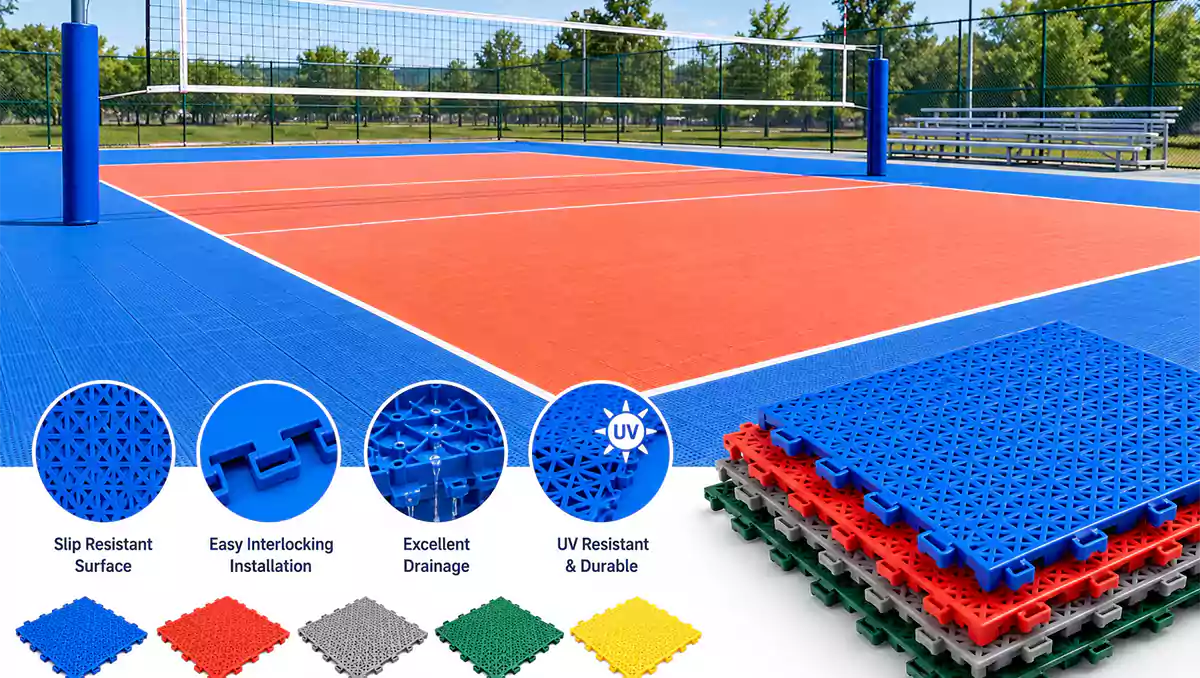
PP interlocking flooring is a modular sports flooring solution made from polypropylene. Its interlocking structure allows individual tiles to connect without complicated installation procedures.
This design makes PP flooring particularly useful for sports facilities that need fast installation, replacement, or maintenance.
For volleyball courts, PP modular flooring can offer several practical advantages.
High Impact Resistance
Volleyball players frequently jump and land on the court. PP sports tiles are designed to withstand repeated impact and intensive sports activity.
Excellent Durability
PP is a durable thermoplastic material. With proper design and maintenance, PP interlocking flooring can provide long-term performance in sports environments.
Easy Installation
One major advantage is the interlocking installation system. Tiles can be connected directly on a suitable base without traditional adhesive installation.
This can significantly reduce installation time.
Easy Replacement
If a tile becomes damaged, the affected section can be removed and replaced individually. There is no need to replace the entire court.
Outdoor Weather Resistance
For outdoor volleyball courts, flooring must handle changing weather conditions. UV-resistant PP flooring can provide better resistance to sunlight and outdoor exposure.
Good Drainage
Many modular sports tiles feature an elevated or perforated structure. Water can pass through the surface and drain below the tiles.
This makes PP interlocking flooring suitable for outdoor volleyball courts where rainwater management is important.
Indoor vs. Outdoor Volleyball Court Flooring
The best flooring choice depends heavily on the court environment.
Indoor Volleyball Court Flooring
Indoor courts are protected from direct sunlight and rain. Therefore, the main priorities are usually:
- Player comfort
- Traction
- Shock absorption
- Surface consistency
- Durability
- Easy maintenance
Wood, PVC, rubber, and modular sports flooring can all be considered for indoor applications.
For training facilities and multipurpose gyms, modular flooring can also provide installation flexibility.
Outdoor Volleyball Court Flooring
Outdoor volleyball courts require additional protection against environmental conditions.
Important factors include:
- UV resistance
- Water drainage
- Weather resistance
- Temperature changes
- Impact resistance
- Easy cleaning
- Fast installation
For these applications, PP interlocking sports flooring can be an attractive option because its modular structure supports drainage and makes maintenance easier.
Key Factors When Choosing Volleyball Court Flooring
Before purchasing a volleyball flooring system, consider the following factors.
1. Surface Traction
The floor should provide sufficient grip for quick movements without feeling excessively sticky.
2. Shock Absorption
A sports floor should provide an appropriate level of impact protection and player comfort.
3. Durability
Consider how frequently the court will be used. High-traffic facilities need flooring designed for intensive use.
4. Weather Resistance
Outdoor courts require UV-resistant and weather-resistant materials.
5. Drainage
For outdoor applications, water drainage can help the court dry faster after rainfall.
6. Installation Method
Interlocking systems can simplify installation and reduce the need for specialized equipment.
7. Maintenance
Choose a flooring system that is easy to clean and allows damaged sections to be repaired quickly.
8. Custom Colors and Court Design
Volleyball courts often use contrasting colors to define the playing area and improve visual appeal. Modular tiles are available in different colors, allowing manufacturers and facility owners to create customized court designs.
How to Install PP Interlocking Volleyball Court Flooring
One of the biggest advantages of modular PP flooring is its relatively simple installation process.
Step 1: Prepare the Base
Start with a stable, clean, and reasonably level surface. Remove dust, debris, and other obstacles.
Step 2: Plan the Court Layout
Measure the playing area and determine the tile layout before installation. Planning the layout can reduce cutting and material waste.
Step 3: Start From One Corner
Place the first tile in the selected starting position. Make sure it is correctly aligned.
Step 4: Connect the Tiles
Connect additional tiles through the interlocking edges. Continue row by row until the required area is covered.
Step 5: Install Edge Accessories
Depending on the court design, edge ramps or other accessories can be installed around the perimeter.
Step 6: Mark the Volleyball Court
After installing the flooring, apply suitable court markings according to the intended volleyball court layout.
How to Maintain Volleyball Court Flooring
Proper maintenance can extend the service life of a volleyball court.
For routine maintenance:
- Remove dust and loose debris regularly.
- Clean the surface with suitable mild cleaning products.
- Avoid harsh chemicals that may damage the flooring.
- Remove standing water from outdoor courts when necessary.
- Check interlocking connections periodically.
- Replace damaged tiles promptly.
For outdoor PP flooring, keeping the drainage area clean is especially important. Leaves, dirt, and other debris can reduce drainage efficiency.
PP Flooring vs. Traditional Volleyball Flooring
Traditional sports flooring can provide excellent performance, but it may require more complicated installation or maintenance.
PP interlocking flooring offers a different approach.
| Feature | PP Interlocking Flooring | Traditional Sports Flooring |
|---|---|---|
| Installation | Fast interlocking installation | Often requires professional installation |
| Replacement | Individual tiles can be replaced | Repairs can be more complicated |
| Outdoor Use | Suitable for many outdoor applications | Depends on material |
| Drainage | Available with drainage designs | Depends on system |
| Maintenance | Easy to maintain | Varies by material |
| Custom Colors | Available | Depends on flooring type |
| Portability | Modular and removable | Usually permanent |
Therefore, PP flooring can be particularly useful for facilities that value flexibility and easy maintenance.
Where Can Volleyball Court Flooring Be Used?
Modern volleyball flooring can be used in many different environments, including:
- Indoor volleyball gyms
- Outdoor volleyball courts
- Schools and universities
- Sports clubs
- Community recreation centers
- Training facilities
- Multipurpose sports courts
- Resorts and recreational areas
- Temporary sports venues
- Backyard volleyball courts
Because interlocking flooring can be installed and removed relatively easily, it is also suitable for facilities that need to change their court layout over time.
How to Choose the Best Volleyball Court Flooring
There is no single flooring solution for every volleyball facility. Instead, consider the specific requirements of your project.
For an indoor professional or high-level training facility, player comfort, shock absorption, traction, and surface consistency may be the highest priorities.
For an outdoor recreational court, however, weather resistance, drainage, durability, and easy maintenance may be more important.
If you need a flexible outdoor solution, PP interlocking volleyball court flooring is worth considering. Its modular construction provides convenient installation, replacement, and maintenance while supporting a durable sports surface.
Conclusion
The right volleyball court flooring can improve player comfort, court durability, and overall facility performance. When selecting a surface, consider traction, impact resistance, durability, weather resistance, drainage, installation, and maintenance requirements.
For outdoor and multipurpose applications, PP interlocking sports flooring provides a practical combination of durability, modular installation, drainage, and easy maintenance.
By choosing the right flooring material and court design, sports facilities can create a safer, more attractive, and longer-lasting volleyball playing environment.