

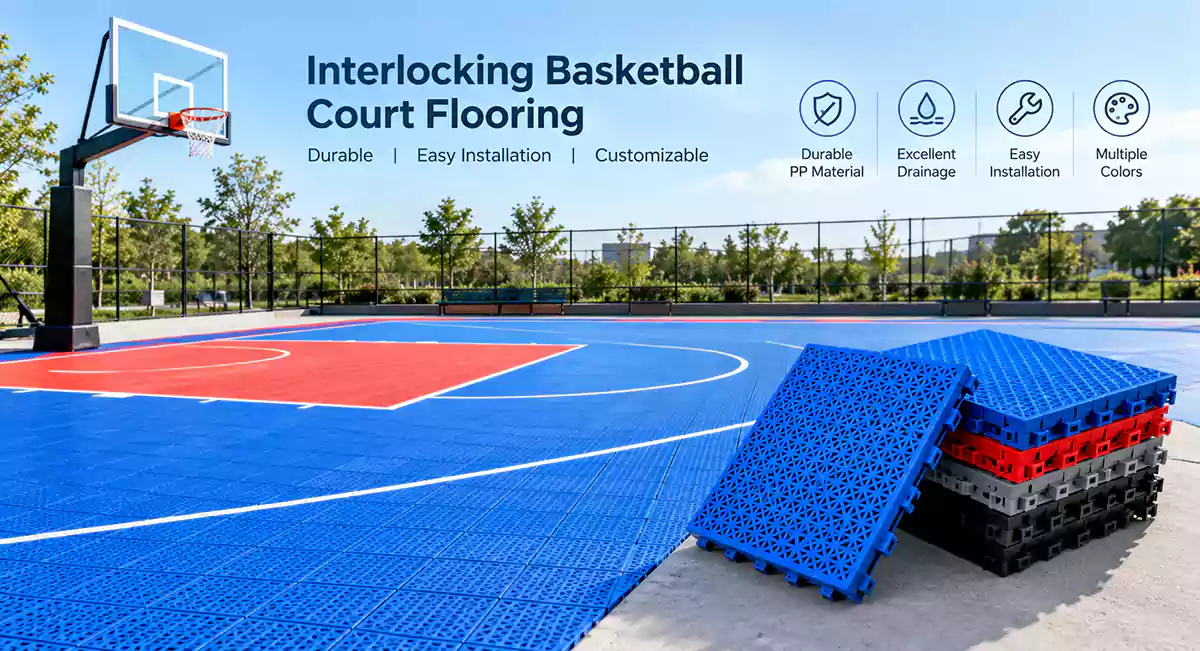

Interlocking Basketball Court Flooring: A Complete Guide to Modular Basketball Court Tiles
Choosing the right basketball court flooring is essential for creating a durable, comfortable, and visually appealing playing surface. Whether you are building a backyard basketball court, a school sports facility, a community playground, or a commercial basketball court, interlocking basketball court flooring offers a practical and flexible solution.
Manufacturers use durable polypropylene (PP) to produce modular interlocking basketball court tiles that offer easy installation, reliable outdoor performance, and customizable court layouts.Compared with traditional poured or permanently installed surfaces, these modular tiles offer greater flexibility for new installations, renovations, and temporary sports facilities.
In this guide, we will explain how interlocking basketball court flooring works, its key benefits, common applications, and what to consider when choosing a reliable basketball court flooring manufacturer.
What Is Interlocking Basketball Court Flooring?
Interlocking basketball court flooring is a modular sports flooring system made of individual tiles that connect through a specially designed locking mechanism. The tiles fit together to form a continuous playing surface without requiring permanent bonding across the entire court.
Manufacturers use polypropylene (PP), a durable and lightweight thermoplastic, to produce most modular basketball court tiles for outdoor sports flooring applications.
Each tile typically features a textured playing surface, a supportive base structure, and interlocking connectors along its edges. Depending on the design, the underside may include a grid structure that helps support the tile and allows airflow and drainage.
Once assembled, the tiles create a stable surface suitable for basketball practice, recreational games, and various multi-purpose sports applications.
For distributors, contractors, and project buyers, interlocking basketball court tiles also provide a convenient solution for transporting, installing, maintaining, and expanding sports flooring systems.
Key Benefits of PP Interlocking Basketball Court Flooring
1. Easy and Fast Installation
One of the main advantages of modular basketball court flooring is its straightforward installation process. The tiles connect through integrated locking systems, reducing the need for complicated construction procedures.
For many projects, the installation process involves preparing a suitable, level subbase, laying out the tiles, connecting the modules, and installing compatible edge ramps where needed.
Compared with some traditional sports flooring systems, PP interlocking tiles can reduce installation complexity and help shorten project timelines.
This makes them an attractive option for sports contractors, schools, recreational facilities, and property owners looking for an efficient basketball court flooring solution.
2. Durable Polypropylene Material
High-quality PP basketball court tiles are designed to withstand regular recreational sports use and outdoor exposure when the material and product specifications are appropriate for the intended environment.
Polypropylene offers several useful properties:
- Good impact resistance for everyday sports applications
- Resistance to moisture and many common environmental conditions
- Lightweight construction for convenient handling and transportation
- Low-maintenance requirements compared with some traditional surfaces
- Suitability for a variety of indoor and outdoor modular flooring applications
Actual performance depends on the PP formulation, UV stabilization, tile structure, installation conditions, and expected usage. Buyers should confirm these specifications with their basketball court flooring supplier before placing an order.
3. Effective Surface Drainage
Outdoor basketball courts need a flooring system that can manage rainwater efficiently.
Many interlocking basketball court tiles feature perforations or an open-grid base structure that allows water to pass through the surface and drain toward a properly designed subbase.
This structure can help reduce surface water accumulation after rainfall and support faster drying under suitable weather and drainage conditions.
For outdoor basketball courts, drainage performance depends not only on the tiles but also on the slope, permeability, and drainage design of the underlying surface.
A suitable installation base is therefore essential for achieving reliable outdoor performance.
4. Comfortable Playing Surface and Ball Response
The playing experience is an important consideration when selecting basketball court flooring.
Depending on their design, modular PP sports tiles can provide a textured surface for traction and a degree of controlled flexibility underfoot. These characteristics can support comfortable movement during recreational basketball activities.
However, not all interlocking tiles provide the same level of shock absorption, traction, or ball rebound. Performance varies by tile design and system construction.
For school courts, training facilities, and community basketball areas, buyers should evaluate the intended playing level and select a product designed for that application.
For competitive or high-performance facilities, it is especially important to request relevant test data and confirm whether the complete flooring system meets the project’s applicable sports performance requirements.
5. Modular Design and Easy Replacement
Because interlocking basketball court flooring consists of individual modules, damaged tiles can often be removed and replaced without dismantling the entire court.
This modular design simplifies routine maintenance and can reduce the scope of repairs when localized damage occurs.
It also provides flexibility for future projects. A court can potentially be expanded, reconfigured, or relocated if the existing tiles remain suitable for reuse and the new installation conditions are appropriate.
For facility managers and commercial buyers, this flexibility can be valuable over the service life of a sports flooring system.
6. Custom Colors and Basketball Court Designs
A basketball court should be functional while also reflecting the identity of the facility, school, club, or brand.
PP interlocking basketball court tiles are available in different colors, allowing buyers to create customized court layouts.
Common design options include:
- Traditional orange and blue basketball courts
- Blue playing areas with contrasting boundary zones
- Red and gray recreational courts
- School courts featuring institutional colors
- Custom layouts incorporating team or brand colors
Depending on the product and manufacturing capabilities, suppliers may also offer customized dimensions, logos, packaging, and private-label services.
For distributors and project contractors, working directly with a basketball court flooring manufacturer can make it easier to coordinate colors, quantities, and project-specific requirements.
Where Can Interlocking Basketball Court Tiles Be Used?
Modular basketball court flooring is suitable for a range of recreational and sports applications.
Backyard Basketball Courts
Homeowners can use interlocking basketball court tiles to create a dedicated basketball area in a backyard, driveway, or private recreational space, provided the underlying surface is suitable.
The modular format makes it possible to design a half-court, a shooting practice area, or a larger playing surface according to the available space.
School and University Basketball Courts
Schools and universities need sports surfaces that can support frequent recreational use and routine maintenance.
PP modular basketball court tiles can be considered for outdoor practice courts, physical education areas, and multi-purpose recreational facilities.
Project buyers should select tile specifications according to expected traffic, climate conditions, and the school’s maintenance requirements.
Community and Public Basketball Courts
Community sports areas benefit from flooring systems that are practical to install and maintain.
Interlocking basketball court tiles can be used for neighborhood basketball courts, apartment complex recreation areas, and selected public sports projects.
For high-traffic public installations, the product’s wear resistance, UV performance, connection strength, and maintenance requirements should be evaluated carefully.
Sports Clubs and Training Facilities
Basketball clubs and training centers may use modular flooring for practice areas, skills training zones, and recreational courts.
The best choice depends on how the court will be used, including training intensity, player movement, and the desired playing characteristics.
Commercial and Temporary Basketball Courts
Modular tiles can also be suitable for exhibitions, promotional events, temporary sports installations, and multi-purpose commercial recreation spaces.
Their interlocking structure allows the playing surface to be assembled and disassembled when the installation conditions permit.
For temporary projects, buyers should confirm the required subbase, edge protection, and safe installation procedures in advance.
How to Choose the Right Interlocking Basketball Court Flooring
Before purchasing modular basketball court tiles, consider the following factors.
Material Quality and UV Resistance
For outdoor applications, ask whether the PP material includes UV stabilizers and whether the finished tiles have been tested for relevant outdoor exposure requirements.
Material quality can influence color retention, dimensional stability, and long-term performance.
Tile Structure and Load-Bearing Performance
Examine the tile’s top surface, support structure, and interlocking connections.
The product should be suitable for the expected sports activities and installation environment. Request technical specifications and test reports where available instead of relying only on appearance or marketing descriptions.
Traction and Sports Performance
The surface texture should provide appropriate traction for the intended activity.
Ask the supplier about available test results for slip resistance, ball rebound, shock absorption, and other relevant performance characteristics.
These properties vary among products and should not be assumed to be identical across all PP basketball court tiles.
Drainage and Subbase Compatibility
A good modular flooring system needs a compatible installation base.
Confirm whether the tiles are intended for installation over concrete, asphalt, or another properly prepared surface. Check the required flatness, drainage arrangement, expansion allowance, and edge treatment.
An unsuitable subbase can affect the stability and performance of the entire court.
Customization and Supply Capacity
For commercial projects and wholesale orders, product customization and production capacity can be just as important as technical performance.
Consider whether the manufacturer can provide:
- Custom tile colors and court layouts
- Project-based quantity planning
- Compatible edge ramps and accessories
- Sample tiles for evaluation
- Export packaging and shipping coordination
- OEM or private-label options, where available
- Technical documentation and installation guidance
Choosing a manufacturer that understands your project requirements can help streamline purchasing and installation.
Interlocking Basketball Court Flooring vs. Traditional Court Surfaces
Different basketball court surfaces offer different advantages. The most appropriate option depends on the project budget, playing requirements, installation conditions, and long-term maintenance plan.
| Feature | PP Interlocking Tiles | Poured or Coated Surfaces |
|---|---|---|
| Installation | Modular assembly | Requires surface preparation and coating or construction work |
| Repair | Individual tiles may be replaceable | Localized repairs may require patching or recoating |
| Customization | Modular color combinations | Custom colors and court markings are possible |
| Drainage | Depends on tile openings and subbase design | Depends on surface slope and drainage design |
| Portability | Potentially reusable in suitable conditions | Generally designed as a permanent surface |
| Maintenance | Routine cleaning and tile inspection | Depends on the surface material and coating system |
| Playing performance | Depends on tile design and system specifications | Depends on the selected surface system |
PP interlocking tiles are particularly attractive when modular installation, flexible layouts, and convenient localized replacement are priorities. Traditional systems may be preferable for projects with specific seamless-surface or established sports-surface requirements.
The best choice should be based on the intended application rather than price alone.
How to Install Interlocking Basketball Court Flooring
A properly prepared base and careful installation are essential for a stable playing surface.
Step 1: Prepare the Subbase
Use a firm, stable, and sufficiently level surface suitable for the selected tile system. Concrete and asphalt are common options, but the manufacturer’s installation instructions should determine the final requirements.
Step 2: Plan the Court Layout
Measure the available area and determine the court dimensions, tile quantity, color arrangement, and position of the basketball hoop.
Allow for compatible edge ramps, boundary areas, and other accessories where required.
Step 3: Install the Tiles
Begin from a suitable starting point and connect the tiles row by row using the integrated locking system. Follow the manufacturer’s recommended assembly direction and connection procedure.
Step 4: Add Edges and Accessories
Install compatible edge ramps and other specified accessories to create appropriate transitions around the court perimeter.
Step 5: Inspect the Completed Surface
Check the connections, surface alignment, edges, and drainage. Confirm that the installed system is suitable for use before opening the court to players.
Always follow the product-specific installation manual, including any requirements for perimeter expansion gaps or temperature-related movement.
Why Work Directly with a Basketball Court Flooring Manufacturer?
For wholesalers, distributors, contractors, and sports facility developers, purchasing directly from a manufacturer can simplify product selection and project coordination.
A professional PP interlocking basketball court flooring manufacturer can help buyers compare product structures, select suitable specifications, coordinate color combinations, and plan order quantities.
Direct manufacturer communication can also make it easier to discuss sample requests, production lead times, packaging requirements, export documentation, and customized orders.
When comparing suppliers, look beyond the quoted unit price. Evaluate material specifications, quality-control procedures, product consistency, communication efficiency, and the supplier’s ability to support your intended application.
For large projects, request samples and technical documentation before confirming the final order.
Frequently Asked Questions About Interlocking Basketball Court Flooring
Are interlocking basketball court tiles suitable for outdoor use?
Yes, outdoor-rated PP basketball court tiles can be suitable for outdoor use. However, buyers should confirm the product’s UV resistance, weather suitability, drainage design, and installation requirements.
Can I install PP basketball court flooring over concrete?
Many modular basketball court tile systems can be installed over properly prepared concrete. The surface must meet the manufacturer’s requirements for stability, flatness, drainage, and expansion allowance.
Are interlocking basketball court tiles easy to maintain?
Generally, yes. Routine maintenance typically involves removing dirt and debris, cleaning the surface with suitable methods, and inspecting the connections and damaged areas. Follow the manufacturer’s cleaning recommendations.
Can damaged basketball court tiles be replaced?
In many modular systems, individual damaged tiles can be disconnected and replaced. Replacement compatibility depends on the tile model and locking system.
Can I customize the color of my basketball court?
Many manufacturers offer multiple tile colors and can arrange custom color combinations for different court zones. Customization options and minimum order quantities vary by supplier.
How many interlocking basketball court tiles do I need?
The required quantity depends on the court dimensions and the effective coverage area of each tile.
A basic estimate is:
Required tiles = Total court area ÷ Coverage area per tile
Add an appropriate allowance for cutting, layout adjustments, spare tiles, and any product-specific installation requirements. For modular square tiles, the manufacturer can help calculate the quantity from the selected tile dimensions and court layout.
How long does interlocking basketball court flooring last?
Service life depends on material formulation, UV stabilization, installation quality, usage intensity, climate, and maintenance. Ask the manufacturer for product-specific durability information and any available test data or warranty terms.
Get a Quote for Interlocking Basketball Court Flooring
Are you sourcing interlocking basketball court flooring for a distributor business, sports facility, school, or commercial project?
As a PP interlocking sports flooring manufacturer, we can discuss product specifications, tile colors, court layouts, accessories, and bulk order requirements based on your project needs.
Contact our team to request product details, samples, and a customized quotation for your next basketball court flooring project.
Tell us your required court size, application, preferred colors, and estimated order quantity to get started.