


Floor Tiles for Garage: A Complete Guide to Durable, Easy-to-Install Garage Flooring
Looking for the best floor tiles for garage spaces? PP interlocking garage floor tiles are a practical solution for homeowners, automotive enthusiasts, garage renovation contractors, and commercial flooring distributors. Designed with a modular structure and easy-to-connect panels, these tiles can help transform an ordinary concrete garage floor into a cleaner, more organized, and more attractive space.
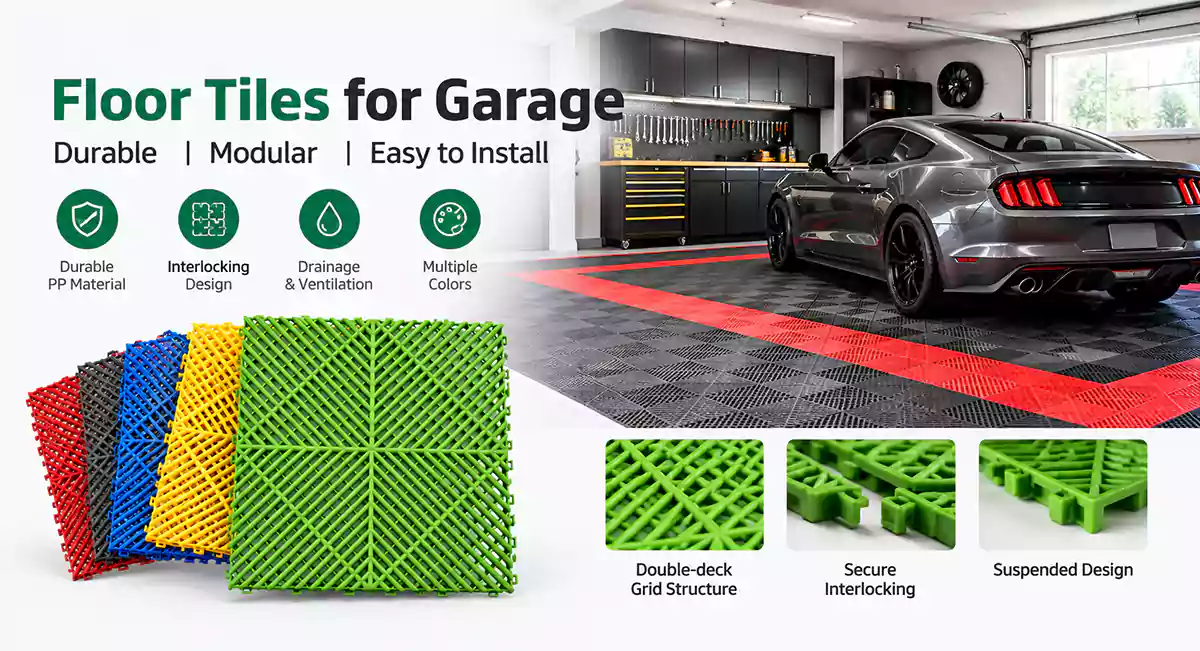
Our polypropylene (PP) suspended garage floor tiles feature an upgraded double-deck grid structure, a distinctive surface pattern, and a range of vibrant color options. Whether you are upgrading a home garage, creating a car display area, or sourcing flooring products for your business, modular PP garage floor tiles offer a flexible flooring solution.
In this guide, we will explain how to choose garage floor tiles, explore the benefits of PP interlocking tiles, and help you find the right flooring solution for your project.
What Are Floor Tiles for Garage?
Garage floor tiles are modular flooring panels designed to cover existing garage floors. Unlike traditional epoxy coatings or poured concrete finishes, interlocking floor tiles are installed as individual panels that connect to create a continuous flooring surface.
PP garage floor tiles are manufactured from polypropylene, a thermoplastic material commonly used in durable plastic products. Their modular design makes them suitable for a variety of residential and commercial applications, depending on the tile’s load-bearing capacity and installation requirements.
Our suspended PP garage floor tiles feature an open-grid structure that gives the product a distinctive appearance while allowing air and water to move through the openings. The double-deck grid construction provides a structured panel design for suitable garage and utility flooring applications.
Key product features include:
- Interlocking modular design: Individual panels connect to form a larger flooring area.
- PP material construction: Polypropylene provides a lightweight and practical material option for modular flooring.
- Suspended grid structure: The open design can help water pass beneath the tile surface when installed on an appropriately prepared floor.
- Multiple color options: Red, blue, green, yellow, and other available colors allow different design combinations.
- Flexible installation layouts: Modular panels can be arranged to suit different room dimensions and design preferences.
- Easy replacement: Individual panels can generally be removed and replaced without rebuilding the entire floor.
For projects involving heavy vehicles, floor jacks, concentrated wheel loads, or demanding workshop operations, buyers should confirm the product’s load rating and intended application before purchasing.
Why Choose PP Interlocking Floor Tiles for Garage?
Choosing the right garage flooring involves more than appearance. Durability, installation, maintenance, drainage, and long-term value all matter.
1. Easy Installation Without Complicated Construction
One of the main advantages of interlocking garage floor tiles is their modular installation method. The panels connect through integrated locking edges, allowing installers to assemble the flooring without applying adhesive across the entire floor.
For many projects, the existing concrete floor can serve as the base, provided it is sufficiently level, stable, clean, and suitable for the intended use.
The general installation process includes:
- Clean the existing garage floor and remove loose debris.
- Check that the surface is stable and reasonably level.
- Plan the layout and select the desired tile colors.
- Connect the panels row by row using the interlocking edges.
- Install perimeter finishing pieces or cut edge panels where appropriate.
- Inspect the finished floor and confirm that all connections are secure.
The modular design can reduce installation complexity compared with some permanent flooring systems. Actual installation time depends on the area, layout, edge details, and site conditions.
2. Upgraded Double-Deck Grid Structure
The structure of a garage floor tile plays an important role in its intended application.
Our upgraded double-deck grid design combines a patterned upper surface with an underlying support structure. This configuration creates a suspended-style panel that can provide clearance beneath the walking surface when installed as designed.
Potential benefits of an open-grid design include:
- Allowing water to pass through the surface openings.
- Helping reduce direct contact between the walking surface and water beneath the panel.
- Supporting airflow beneath the tiles.
- Creating a distinctive textured appearance for garage interiors.
These benefits depend on the installation environment. Water still needs somewhere to drain, and an open-grid floor does not replace proper floor drainage or waterproofing.
For buyers planning to use the tiles in a vehicle garage, it is also important to verify load capacity, dimensional stability, and resistance to the chemicals and temperatures expected in the application.
3. Multiple Colors for Customized Garage Designs
Garage flooring is increasingly used as part of a property’s overall appearance. A coordinated floor can make a home garage, showroom, or automotive workspace look more professional.
Our PP interlocking floor tiles are available in multiple color options, including green, red, blue, and yellow, depending on the product range.
Different colors can be combined to create:
- Checkerboard garage floors.
- Contrasting borders around parking spaces.
- Racing-inspired automotive displays.
- Color-coded work zones.
- Branded showroom flooring.
- Customized flooring designs for retail and commercial projects.
For example, a black-and-red combination can create a sporty automotive appearance, while blue and gray tones can suit a clean, modern workshop. Bright colors can also help visually distinguish parking areas and designated workspaces.
Color availability, minimum order quantities, and custom color options can be confirmed when requesting a quotation.
4. Modular Maintenance and Replacement
Traditional continuous flooring systems can require more extensive repairs when a section becomes damaged. With interlocking garage floor tiles, individual panels can often be removed and replaced when necessary.
Routine maintenance may include sweeping loose dirt, removing debris from the tile openings, and washing the surface with a suitable cleaning solution.
For garages exposed to oil, grease, fuel, brake fluid, or other automotive chemicals, the cleaning procedure should follow the manufacturer’s recommendations. Chemical resistance varies by formulation and exposure conditions.
Regular inspection is also recommended to check for loose connections, damaged panels, and debris beneath the suspended flooring.
5. Flexible Applications Beyond Home Garages
Although garage floor tiles are a popular choice for residential garages, modular PP flooring can also be considered for other suitable applications.
Potential applications include:
- Home garages and parking areas.
- Automotive showrooms and vehicle display areas.
- Workshops and utility rooms.
- Storage areas.
- Selected commercial and industrial spaces.
- Temporary or semi-permanent flooring projects where the product specifications are appropriate.
The correct tile depends on the intended use. Areas with heavy industrial equipment, high point loads, forklift traffic, or strict fire-safety requirements may require a different flooring specification.
PP Garage Floor Tiles vs. Epoxy Flooring
When comparing garage flooring options, PP interlocking tiles and epoxy coatings offer different advantages.
| Feature | PP Interlocking Garage Tiles | Epoxy Garage Flooring |
|---|---|---|
| Installation | Modular panel assembly | Surface preparation and coating application |
| Installation downtime | Often relatively short | Depends on preparation, curing, and coating system |
| Floor structure | Individual connected panels | Continuous coating over the substrate |
| Drainage | Open-grid models can allow water to pass through | Typically requires a separate drainage solution |
| Maintenance | Individual panels may be replaceable | Localized coating repairs may be needed |
| Design | Multiple colors and modular patterns | Various colors and decorative finishes |
| Subfloor requirements | Stable, suitable base required | Properly prepared concrete required |
| Best suited for | Projects needing modular, replaceable flooring | Projects seeking a continuous coated surface |
Neither option is universally better. Epoxy may be appropriate when a seamless, easy-to-clean surface is the priority. PP interlocking tiles may be attractive when modular installation, design flexibility, and panel replacement are important.
For garages where liquids must be fully contained, or where hygiene and chemical-control requirements are strict, an open-grid tile may not be the appropriate choice.
How to Choose the Best Floor Tiles for Garage
Before ordering garage flooring, consider the following factors.
1. Load-Bearing Capacity
Vehicle weight is one of the most important considerations when selecting garage floor tiles.
A tile that performs well under normal foot traffic may not be suitable for a passenger vehicle, SUV, truck, or workshop equipment.
Ask the manufacturer for relevant test data, including:
- Maximum recommended vehicle or wheel load.
- Static and dynamic load performance.
- Concentrated-load performance.
- Performance on the intended subfloor.
- Resistance to deformation under expected service conditions.
Do not select a tile based on appearance or material type alone. The finished installation must be suitable for the actual loads.
2. Tile Size and Thickness
Tile dimensions affect installation speed, layout planning, and the total number of panels required.
Before placing an order, confirm the tile’s length, width, height, thickness, connection design, and coverage per piece.
The number of tiles needed can be estimated using this formula:
Number of tiles = Total floor area ÷ Coverage area per tile
For example, a 200-square-foot garage using tiles that cover 1 square foot each would require approximately 200 tiles before allowing for cutting, perimeter finishing, and spare panels.
Always use the actual coverage dimensions provided by the manufacturer when calculating quantities.
3. Surface Design and Drainage
Open-grid tiles and solid-top tiles serve different purposes.
Open-grid tiles can allow water and debris to pass through the surface openings, making them worth considering for certain garages and utility areas. However, dirt can accumulate underneath, so access for cleaning is important.
Solid-top tiles may be preferable when a more continuous walking surface is needed.
Consider the amount of water, oil, dust, and other contaminants expected in the space before choosing a surface style.
4. Material Quality
Not all PP floor tiles are manufactured to the same specifications.
When comparing suppliers, ask about the polypropylene formulation, manufacturing consistency, dimensional tolerances, locking strength, color stability, and quality-control procedures.
For outdoor or semi-outdoor installations, also confirm whether the product is designed for UV exposure, temperature fluctuations, and local environmental conditions.
5. Installation Environment
A successful installation depends on both the tile and the surface underneath it.
Check whether the existing floor is level, whether water can drain properly, and whether the tiles are compatible with the expected temperature and traffic conditions.
If the garage has expansion joints, floor drains, ramps, or uneven areas, discuss the layout with the supplier before installation.
Why Buy Garage Floor Tiles Directly from a Manufacturer?
For distributors, importers, wholesalers, and project buyers, working directly with a PP garage floor tile manufacturer can offer advantages beyond the product itself.
Factory Supply and Bulk Purchasing
Direct sourcing can simplify communication about product specifications, packaging, production schedules, and order quantities.
For wholesale projects, buyers can request quotations based on the required quantity, destination market, packaging requirements, and shipping arrangements.
Multiple Color Options
A range of colors allows distributors to develop different product combinations for local markets and customer preferences.
If you are building your own garage flooring brand, ask whether the supplier supports custom color development and branding options.
OEM and ODM Cooperation
For businesses seeking private-label products, OEM and ODM cooperation may include custom packaging, product branding, color selection, and product development, subject to the manufacturer’s capabilities and minimum order requirements.
Before confirming an order, request samples and review the relevant specifications to ensure that the product meets your market’s requirements.
Consistent Quality Control
For repeat orders, consistency is important. Buyers should discuss quality standards, inspection procedures, packaging, batch consistency, and documentation before production.
A qualified supplier should be able to explain the product’s intended application and provide available technical information to support purchasing decisions.
Frequently Asked Questions About Floor Tiles for Garage
Are PP interlocking tiles suitable for car garages?
They can be suitable for certain car garages, provided the tile is specifically designed and tested for vehicle traffic. Check the recommended wheel load, connection strength, subfloor requirements, and exposure conditions before installation.
Can I install garage floor tiles over concrete?
Many interlocking garage floor tiles are designed for installation over an existing concrete floor. The concrete should be stable, clean, and sufficiently level, and the installation must follow the product manufacturer’s instructions.
Do suspended garage floor tiles allow water to drain?
Open-grid suspended tiles allow water to pass through their openings. However, drainage depends on the underlying floor, slope, drains, and site conditions. The tiles themselves do not guarantee that water will drain away.
Are PP garage floor tiles easy to clean?
Routine cleaning is generally straightforward and may involve sweeping, vacuuming where suitable, or washing with an approved cleaning solution. Open-grid tiles may require occasional cleaning underneath to remove trapped dirt and debris.
Can I combine different colors of garage floor tiles?
Yes, when the panels share the same compatible dimensions and locking system. Multiple colors can be arranged in contrasting patterns, borders, or designated zones. Confirm compatibility before mixing different models.
How many garage floor tiles do I need?
Measure the length and width of the installation area and calculate the total floor area. Divide that area by the coverage area of one tile, then allow additional panels for cutting, edge finishing, and replacements.
What should wholesalers look for when sourcing PP garage floor tiles?
Wholesalers should compare material specifications, load-bearing test data, tile dimensions, locking design, available colors, packaging, minimum order quantities, production lead times, and shipping terms. Samples and technical documentation are useful before placing a bulk order.
Get a Quote for PP Interlocking Garage Floor Tiles
Looking for a reliable supplier of floor tiles for garage projects?
Our PP suspended interlocking floor tiles feature an upgraded double-deck grid design and multiple color options for suitable residential, commercial, and automotive flooring applications.
Whether you are a flooring distributor, importer, wholesaler, project contractor, or private-label brand owner, we welcome inquiries for product specifications and bulk purchasing.
Contact our team to discuss your requirements, including:
- Product dimensions and technical specifications.
- Available colors and customized color options.
- Load-bearing performance and application suitability.
- Sample availability.
- OEM and ODM requirements.
- Wholesale pricing and minimum order quantities.
- Packaging, production lead times, and shipping arrangements.
Request a quotation today and explore a modular PP garage flooring solution tailored to your market.