

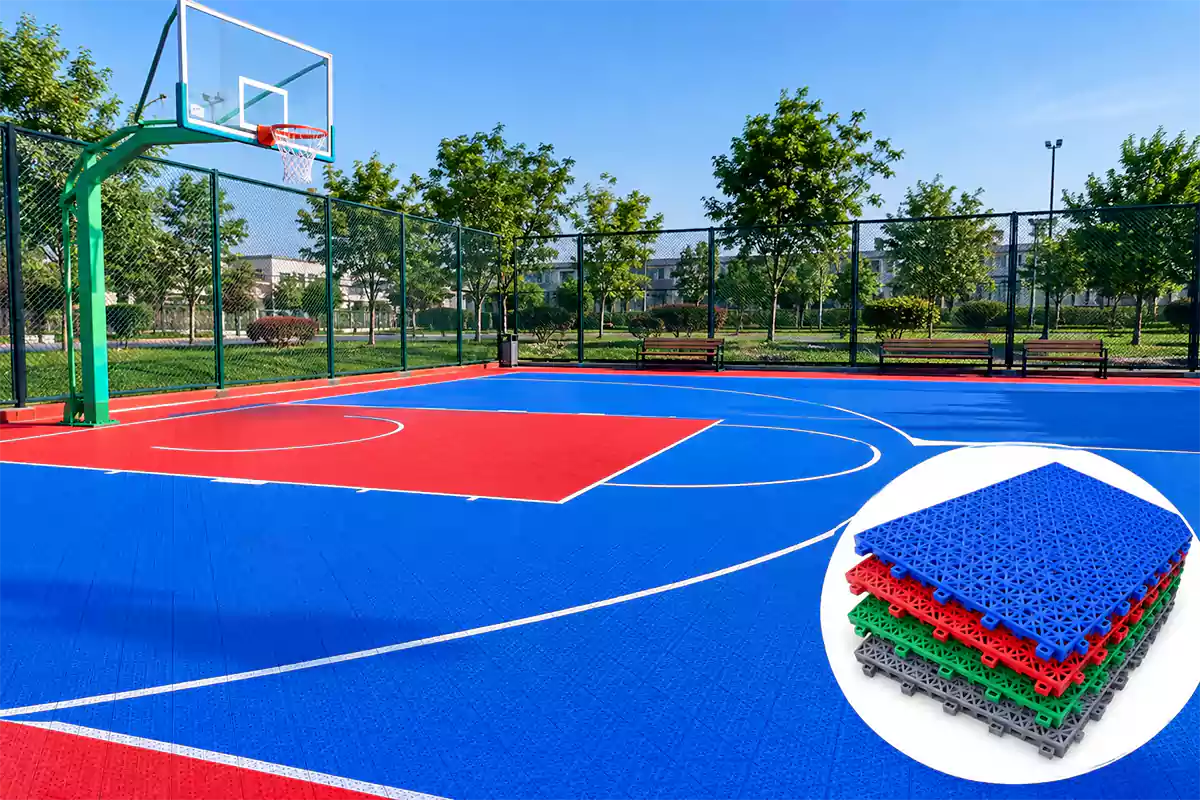

Basketball Court Flooring: How to Choose the Best Surface for Indoor and Outdoor Courts
Choosing the right basketball court flooring is important for player safety, performance, and long-term court durability. A good basketball floor should provide reliable traction, impact resistance, and comfortable foot support. At the same time, it should withstand frequent use and changing environmental conditions.
Today, basketball courts can use different flooring systems, including hardwood, PVC, rubber, PP interlocking tiles, and TPE flooring. However, the best option depends on the court location, usage, budget, and maintenance requirements.
What Is Basketball Court Flooring?
Basketball court flooring is the surface installed over a prepared subfloor to create a suitable playing area. It needs to support running, jumping, stopping, and quick changes of direction.
Therefore, a quality basketball court floor should balance several factors:
- Good traction
- Shock absorption
- Surface durability
- Comfortable foot support
- Easy maintenance
- Resistance to moisture and weather
- Simple installation or replacement
For outdoor courts, flooring also needs to handle sunlight, rain, temperature changes, and regular outdoor exposure.
Common Types of Basketball Court Flooring
There are several popular basketball court flooring options available.
1. Hardwood Basketball Flooring
Hardwood is widely associated with professional and indoor basketball courts. It offers a smooth playing surface and a traditional appearance.
However, hardwood requires careful maintenance. It can also be more sensitive to moisture and temperature changes. As a result, it is usually more suitable for controlled indoor environments.
2. PVC Basketball Flooring
PVC sports flooring provides a relatively comfortable surface and is commonly used in indoor sports facilities. It can offer good traction and easy cleaning.
However, installation may require more preparation. Replacement can also be less convenient than modular flooring systems.
3. Rubber Basketball Flooring
Rubber flooring provides good shock absorption and durability. It can be used in gyms and multi-purpose sports facilities.
On the other hand, rubber flooring can be heavier and may require professional installation depending on the system.
4. PP Interlocking Basketball Flooring
PP interlocking flooring is a practical option for outdoor and multi-purpose basketball courts.
The tiles connect through an interlocking system. Therefore, installation does not require complicated construction methods. Individual tiles can also be removed and replaced when necessary.
PP flooring can provide:
- High durability
- Good impact resistance
- UV resistance
- Slip-resistant performance
- Easy installation
- Low maintenance
- Excellent drainage when installed as a suspended system
These features make PP interlocking flooring particularly suitable for outdoor basketball courts.
PP Basketball Court Flooring for Outdoor Courts
Outdoor basketball courts face more environmental challenges than indoor courts. Rain, sunlight, dust, and temperature changes can affect the playing surface.
Fortunately, PP interlocking basketball flooring is designed for outdoor applications. The modular structure allows water to move through drainage gaps when the system is designed with an appropriate drainage structure.
In addition, PP material does not absorb water like many wood-based materials. This helps make the flooring suitable for areas exposed to moisture.
UV-resistant PP flooring can also provide better protection against long-term sunlight exposure.
TPE Basketball Court Flooring
TPE is another option for basketball court applications. Compared with traditional rigid plastic flooring, TPE can provide a softer and more elastic surface feel.
TPE flooring can offer:
- Improved elasticity
- Better shock absorption
- Softer surface comfort
- Good sports performance
- Suitable support for frequent athletic activity
Therefore, TPE basketball flooring can be considered when player comfort and cushioning are major priorities.
For projects that require a balance between durability, installation efficiency, and cost, PP remains a practical choice. For premium sports applications where additional elasticity is important, TPE can be considered.
What Makes a Good Basketball Court Floor?
When selecting basketball court flooring, buyers should look beyond appearance. The playing surface needs to perform well under repeated athletic activity.
Shock Absorption
Basketball involves frequent jumping and landing. Therefore, adequate shock absorption can help create a more comfortable playing environment.
Slip Resistance
Players need reliable traction when accelerating, stopping, and changing direction. A suitable basketball court surface should provide consistent grip without becoming excessively rough.
Durability
A basketball court can experience thousands of footsteps, impacts, and rapid movements. Durable flooring can help reduce replacement and maintenance costs.
Weather Resistance
Outdoor basketball courts need protection from sunlight, rain, and temperature changes. UV-resistant and weather-resistant flooring is therefore important for outdoor applications.
Easy Installation
Interlocking tiles can simplify the installation process. The modular design allows installers to connect individual tiles without complicated adhesive-based installation.
Easy Maintenance
A low-maintenance basketball floor can save both time and labor. Regular sweeping and cleaning can help keep the surface attractive and functional.
PP Interlocking Flooring vs. Traditional Basketball Flooring
PP interlocking flooring has several advantages for outdoor basketball courts.
| Feature | PP Interlocking Flooring | Traditional Flooring |
|---|---|---|
| Installation | Fast and modular | Often more complex |
| Replacement | Individual tiles can be replaced | Repairs may require larger sections |
| Outdoor use | Excellent | Depends on material |
| UV resistance | Available | Depends on material |
| Drainage | Available with suspended design | Depends on construction |
| Maintenance | Easy | Varies |
| Portability | High | Usually low |
Because of these advantages, PP interlocking flooring is increasingly attractive for community courts, backyard courts, recreational facilities, and multi-sport areas.
How to Install Basketball Court Flooring
Before installation, the base should be clean, stable, and reasonably level. The installation area should also have an appropriate drainage solution for outdoor projects.
A typical PP interlocking flooring installation includes these steps:
- Prepare and clean the subfloor.
- Check the surface for major uneven areas.
- Plan the tile layout.
- Start from a suitable corner or reference line.
- Connect the interlocking tiles.
- Check that the connections are secure.
- Install edge or transition components where required.
- Add basketball court lines and markings.
- Inspect the complete playing surface.
Because the tiles connect mechanically, installation can be faster than many traditional flooring systems.
How to Maintain Basketball Court Flooring
Proper maintenance helps extend the service life of a basketball court floor.
First, remove dust and dirt regularly. Next, clean the surface with suitable cleaning equipment and mild detergent when necessary.
For outdoor courts, also check the drainage system regularly. Leaves, dirt, and other debris can block drainage openings.
Finally, inspect the interlocking connections from time to time. Replace damaged tiles promptly to maintain a safe and uniform playing surface.
Indoor vs. Outdoor Basketball Court Flooring
Indoor and outdoor courts have different flooring requirements.
Outdoor basketball courts, however, require stronger resistance to UV exposure, moisture, temperature changes, and general weather conditions.
For this reason, PP interlocking flooring can be an excellent solution for outdoor basketball courts. Its modular structure also makes future maintenance and replacement easier.
How to Choose the Right Basketball Court Flooring
Before purchasing basketball court flooring, consider the following questions:
Where will the court be installed?
Indoor and outdoor projects require different performance characteristics.
How often will the court be used?
High-traffic facilities need durable flooring designed for repeated use.
Is drainage important?
Outdoor courts may benefit from a suspended modular system that allows water drainage.
What level of player comfort is required?
PP provides a firm and durable surface, while TPE can provide greater elasticity and cushioning.
How important is easy installation?
Interlocking systems can significantly simplify installation and future replacement.
Conclusion
The right basketball court flooring should provide durability, traction, comfort, and reliable performance. While hardwood, PVC, and rubber remain popular choices for specific applications, modular PP interlocking flooring offers an attractive solution for outdoor and multi-purpose basketball courts.
With its durable construction, UV resistance, modular installation, and easy maintenance, PP basketball court flooring can help create a practical and long-lasting sports surface.
For projects that place greater emphasis on elasticity and player comfort, TPE basketball flooring is another option worth considering. Ultimately, the best basketball court surface depends on the environment, usage requirements, and project budget.