

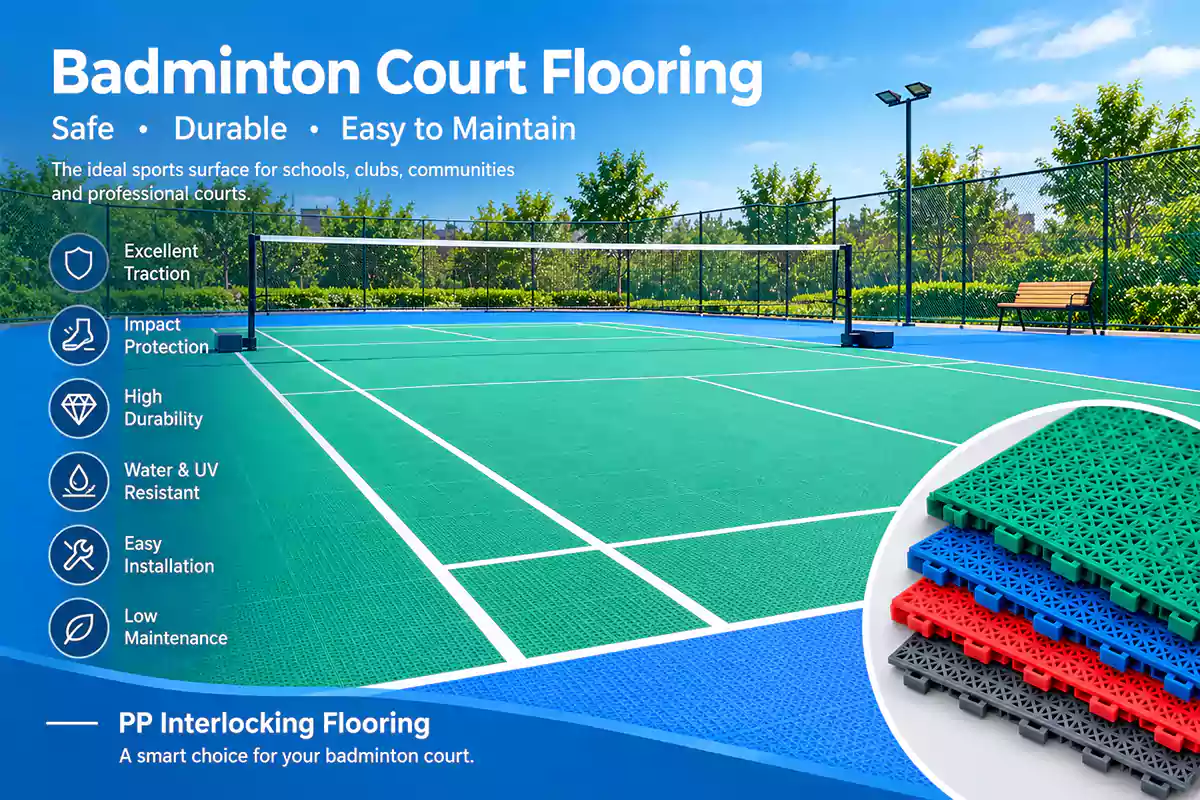

Badminton Court Flooring: A Complete Guide to Choosing the Right Surface
Choosing the right badminton court flooring is essential for player safety, comfort, and court performance. Badminton requires fast movement, sudden stops, and frequent changes of direction. Therefore, the floor needs to provide good traction while reducing stress on players’ feet and joints.
Today, sports facilities can choose from several flooring solutions. These include PVC sports flooring, rubber flooring, wooden floors, and modular interlocking flooring. Among them, PP interlocking flooring offers a practical option for badminton courts, multipurpose sports facilities, schools, clubs, and recreational areas.
In this guide, we explain the key features of badminton court flooring and why modular PP flooring can be a reliable choice.
What Is Badminton Court Flooring?
Badminton court flooring is a specialized sports surface designed for badminton play. Unlike ordinary indoor flooring, it needs to support quick footwork and repeated impact.
A good badminton floor should provide:
- Good traction
- Stable foot support
- Comfortable movement
- Impact resistance
- Long-term durability
- Easy maintenance
- Reliable dimensional stability
In addition, the surface should remain stable during repeated use. This is especially important for sports clubs and commercial facilities with many players every day.
Why Is the Right Badminton Flooring Important?
Badminton is a fast-paced sport. Players constantly move forward, backward, and from side to side. They also perform jumps, lunges, and sudden stops.
Because of this, the flooring directly affects the playing experience.
1. Better Player Safety
First, proper traction helps players maintain control during movement. A suitable sports surface can reduce unwanted slipping while still allowing natural foot movement.
Therefore, choosing a badminton-specific surface is safer than using ordinary tiles or concrete.
2. Improved Playing Comfort
Badminton players spend a lot of time moving quickly around the court. A hard and uncomfortable surface can increase fatigue.
For this reason, sports flooring should provide a suitable balance between firmness and cushioning.
3. Stable Ball and Foot Movement
The floor should remain stable during intense play. A level and consistent surface helps players move confidently and maintain predictable footwork.
4. Long-Term Durability
Badminton courts can receive heavy daily traffic. Consequently, the flooring needs to withstand repeated movement, impacts, and regular cleaning.
Durable materials can help reduce maintenance and replacement costs over time.
Popular Types of Badminton Court Flooring
There are several common flooring options for badminton courts.
PVC Badminton Flooring
PVC sports flooring is widely used for indoor sports facilities. It provides a relatively soft playing surface and can offer good comfort.
However, professional installation usually requires careful subfloor preparation. Installation and replacement can also be more complicated than modular systems.
Wooden Sports Flooring
Wood flooring provides a traditional sports experience. It is often used in professional indoor sports facilities.
However, wood requires more maintenance. Moisture, scratches, and changes in environmental conditions can also affect its performance.
Rubber Flooring
Rubber flooring provides good impact absorption and durability. It is commonly used in gyms and fitness areas.
However, its surface characteristics may not be ideal for every badminton application.
PP Interlocking Flooring
PP interlocking flooring uses a modular tile design. The tiles connect directly with each other and create a continuous sports surface.
As a result, installation can be faster and more convenient. Damaged sections can also be removed and replaced individually.
For schools, clubs, community facilities, and recreational spaces, PP interlocking flooring can provide a practical combination of durability, easy installation, and simple maintenance.
Why Choose PP Interlocking Flooring for Badminton Courts?
PP interlocking flooring has several advantages for badminton court applications.
Easy Installation
One major advantage is the interlocking design. The tiles connect without complicated installation procedures.
Therefore, installers can complete many projects faster than traditional flooring systems.
Depending on the site and product design, the flooring may also be installed over a suitable existing hard surface.
Easy Replacement
Another benefit is modular maintenance.
If one tile becomes damaged, you do not necessarily need to replace the entire floor. Instead, you can remove the affected tile and install a replacement.
This feature is particularly useful for sports clubs and commercial facilities.
Good Impact Resistance
Badminton involves repeated foot impacts and rapid movement. PP flooring provides a strong and durable surface that can handle regular sports use.
As a result, it can be suitable for facilities that require long-term flooring performance.
Moisture Resistance
PP is a plastic material with low water absorption. Therefore, PP interlocking flooring can perform well in areas where moisture may be present.
This feature also makes maintenance easier.
Easy Cleaning
Sports floors need regular cleaning. Fortunately, modular PP flooring can be cleaned with common floor-cleaning methods.
Regular cleaning helps remove dust, sweat, and dirt. It also helps maintain a clean playing environment.
Flexible Applications
PP interlocking flooring is not limited to badminton.
For example, the same modular flooring concept can be used for:
- Badminton courts
- Basketball courts
- Volleyball courts
- Pickleball courts
- Multipurpose sports courts
- School sports areas
- Community recreation areas
- Outdoor sports facilities
Therefore, facilities that support multiple sports can use modular flooring to create flexible playing areas.
Indoor vs. Outdoor Badminton Court Flooring
The environment plays an important role when selecting badminton flooring.
Indoor Badminton Flooring
Indoor courts normally have better environmental control. The flooring should provide stable traction, comfort, and consistent performance.
For indoor facilities, PVC, wood, rubber, and modular sports flooring can all be considered.
Outdoor Badminton Flooring
Outdoor courts face more demanding conditions. The floor may be exposed to sunlight, rain, temperature changes, and dirt.
Therefore, outdoor badminton court flooring should have good weather resistance and dimensional stability.
PP modular flooring can be a practical option for outdoor recreational courts because of its durable plastic construction and interlocking structure.
What Should You Consider When Choosing Badminton Court Flooring?
Before purchasing badminton flooring, consider the following factors.
Surface Traction
The floor should provide reliable grip without feeling excessively sticky. Good traction helps players move and stop with greater confidence.
Shock and Impact Performance
Players make frequent jumps and lunges. Therefore, the flooring should provide an appropriate level of impact protection and playing comfort.
Durability
Consider how often the court will be used. A school court may have different requirements from a professional training facility.
Installation Method
Traditional flooring may require adhesives, specialized tools, and professional installation.
In contrast, interlocking tiles use a modular installation system. This can simplify installation and future repairs.
Maintenance
Choose a floor that is easy to clean and maintain. Low-maintenance flooring can reduce long-term operating costs.
Indoor or Outdoor Use
Always confirm whether the flooring is designed for indoor, outdoor, or both applications.
For outdoor projects, UV resistance and weather performance are particularly important.
How to Maintain Badminton Court Flooring
Regular maintenance can help extend the service life of a badminton court.
First, remove dust and dirt from the surface regularly. A soft broom, vacuum, or suitable mop can help keep the court clean.
Next, clean spills as soon as possible. This helps maintain surface traction and reduces the risk of slipping.
In addition, avoid harsh chemicals that may damage the flooring surface. Always follow the manufacturer’s cleaning recommendations.
Finally, inspect the court regularly. Check for damaged tiles, loose connections, or uneven areas. If you use modular PP flooring, replacing individual damaged tiles can make maintenance easier.
PP Interlocking Flooring vs. Traditional Badminton Flooring
PP interlocking flooring and traditional sports flooring have different advantages.
| Feature | PP Interlocking Flooring | Traditional Sports Flooring |
|---|---|---|
| Installation | Fast modular installation | Often requires professional installation |
| Replacement | Individual tiles can be replaced | Larger sections may need repair |
| Maintenance | Simple | Can require more specialized care |
| Moisture Resistance | Excellent | Depends on material |
| Durability | High | Depends on material |
| Flexibility | Suitable for multipurpose areas | Often designed for specific applications |
| Reusability | Possible with modular systems | Usually more difficult |
The best choice depends on the project. However, facilities that prioritize easy installation, flexible use, and simple maintenance may find modular PP flooring especially attractive.
Is PP Flooring Suitable for Badminton Courts?
PP interlocking flooring can be suitable for badminton courts when the product is specifically engineered for sports use.
However, not all PP tiles have the same performance. When selecting a product, consider the surface texture, traction, impact performance, UV resistance, drainage design, connection strength, and overall construction.
For outdoor courts, the flooring should also be designed to handle changing weather conditions.
Conclusion
Choosing the right badminton court flooring can improve player comfort, safety, and long-term court performance.
Traditional options such as PVC, wood, and rubber remain popular. However, PP interlocking flooring provides several practical advantages. It offers modular installation, good durability, easy maintenance, and convenient tile replacement.
Moreover, PP flooring can support multiple sports applications. This makes it a flexible solution for schools, sports clubs, community facilities, and recreational spaces.
If you are planning a new badminton court, consider the playing environment, expected usage, maintenance requirements, and installation method. With the right flooring system, you can create a durable and practical badminton court for long-term use.